Saturday, March 16, 2013

Innovation in the transportation


This is my last of a three part blog series on the topic of transportation.  Motivated by the Global Engineering Innovation Challenge, my friend and I brainstormed on what can be done to improve the road share in a limited right of way.


The goal is to pack a collection of objects, cars, buses, and bikes, into the minimum number of fixed-size bins, the road lanes. The resemblance between this and the classic bin packing problem is eminent.  In a bin packing problem one may pack based on first fit, or first best fit, based on ascending or descending ordered list of object based on its size.  Here we will be packing based on time of use.


The existing infrastructure of surface transport is sliced in at least three bins
            The side walks at least one on each side
            The roads at least one for each direction, North-South or East-West
Surface -> {Sidewalk, Road1, Road2}

The objects are bikes, cars, buses, and trucks
Items -> {Bikes, Cars, Buses, Trucks}

In solving this problem it is important to consider the time of the week day as the constraint to optimize.
Time -> {   06 < T < 10                   // demand is high because it is morning rush hour
               10 < T < 14                     // demand is low
               14 < T < 20                     // demand is high because it evening rush hour
               20 < T < 24                     // demand is low
            }


The solution is:

Time -> {   06 < T < 10                        Surface -> {Sidewalk        No constraint
                                                                             , Road1       Car-pool, Buses only
                                                                             , Road2  Car-pool, Buses only
                                                                     }

                10 < T < 14                        Surface -> {Sidewalk        No constraint
                                                                             , Road1     Bikes, Cars, Buses, Trucks
                                                                             , Road2  Cars, Buses, Trucks
                                                                      }
                           
               14 < T < 20                         Surface -> {Sidewalk        No constraint
                                                                             , Road1       Car-pool, Buses only
                                                                            , Road2  Car-pool, Buses only
                                                                     }
               20 < T < 24             Surface -> {Sidewalk        No constraint
                                                                , Road1     Bikes, Cars, Buses, Trucks
                                                                , Road2  Cars, Buses, Trucks
                                                                  }
            }


This proposal promotes better, safer sharing of the road by distributing the load of its usage through out the day.

Sunday, February 10, 2013

Challenges of the modern transit planners

Studies show Torontonians commute an average of 80 minutes a day - or when you crunch the numbers, a month in a car.  Thanks to the suburban sprawl or work places out in the boonies :) we now have to spend more time getting to work than before.  We are more involved in extracurricular activities.  We volunteer.  We want to stay employed longer so we take continuing education courses.  We want to live a healthy life so we go to the gym.  We want our kids to learn how to swim, do karate, dance, play hockey, play music, etc., and so we chauffeur them from school to class to home, etc.

In short: we move around a lot.

It is important for us to have access to a good transit system that guarantees safe, efficient, and fast transportation.  Also, it is important for us to have an integrated transit system that enables us to drive, walk, cycle, or take the train or the bus to our destination.  When we are in rush, we want to have access to a rapid transit.  When we are not in a rush we can afford to sit back and enjoy the ride.  We want to be in control of what to choose and when to choose it.  If there is a traffic jam we want to know about it and to know an alternate route to avoid it.


The transit architect has to take all the above into consideration in the planning.


Resources:
TheCityFix.com is an online resource for sustainable transport news, research and “best practice” solutions from around the world    http://thecityfix.com/blog/pedestranged/ 

With the York Region Rapidways project new express lane is being built in the middle of the street for the buses
www.vivanext.com

Efficient sustainable mobility
http://www.frame-online.net/sites/default/files/first-view/further-reading/PlanningGuide.pdf

Other resources provided by the "Global Engineering Innovation" web site.

Saturday, February 02, 2013

High demand on the transportation system

Everyday I join 1,000,000 residents of this city and its suburbs to travel to my destination. Whether it is work, school, day care, store, we all have a route and a way to get to our destination. I take the subway. Then I switch to the bus. I spend close to 40 minutes door to door. Recently I spend more time on the bus, because there is construction. You see they are building a bus rapid transit system in the middle of Highway 7. Although, the road is open and operating, but due to separating the construction site: the workers, the tools, and the machinery, from the rest of the road, there is traffic and cars move very slowly. The 40 minutes travel time takes 50% more. I spend roughly 20 more minutes in the bus each way. If I produced 7 units of work each day, my productivity level dips to 6.6 units of work. That's if I don't adjust my arrival to and departure from work times to make up for the lost time. This is just one of the impacts of changing the surface transit operation to address the increase in usage. One can only imagine that the impact is much larger to local community that need shop, play and live there.


What I am living day in and day out, happens as a result of population growth in an urban area.  The existing transportation system is not able to meet the demand.  Therefore expansion of the roads become necessary but this comes at the cost of severely disrupting the life of the local community.


If money was abundant we would finish such projects in a week or two.  In reality, however, the timeline is around two to four years.  The thought of  having the construction workers in the backyard for that long of a time, even makes the most easy-going people cringe. 

What are some of the strategies to reduce the negative impacts of road expansion projects?

This is one of the three questions in the "Global Engineering Innovation Challenge".

 "     How can we balance the needs of surface transit operations, drivers, cyclists and pedestrians that use streets with limited right-of-way, safer, faster and more reliable, in a way that is acceptable to the local community?"

Monday, December 24, 2012

The End of Growth, Jeff Rubin

Mayan predicted December 21, 2012 to be the end of the world.  They were not the first to herald apocalypse.  According to wikipedia there are 150 predictions of the end of the world prior to the Mayan's. Some predict a clash of Earth with obscure objects in the milky-way will end it all others predict that there will be a nuclear war.  Despite radically different ways each predict the world will end, there is one common theme: life on Earth as we know it today will dramatically change. Thankfully none of these predictions have rung true. 
But, we cannot deny the gradual shift that has been happening over the past two decades in the world.  The world reached its 7 billionth inhabitant in 2011.  How can the definite resources sustain the indefinite growth?
Jeff Rubin's The End of Growth explains the changes in the context of oil possession, consumption and acquisition.  The appetite for oil has been on the rise and so has its price, from $20 a barrel to $120, the oil price have been steadily rising.  Rubin argues the world's dependency on oil is at the root of most political unrest, long term wars and foreign interventions in domestic politics of oil rich countries. While we can control the amount of energy we consume or conserve, we tend to see, most governments shift towards consumption of energy.  But, reducing the oil consumption is not an impossible tasks.  Rubin talks about how Danes curbed their appetite for oil and the consequence of that is "rosy-cheeked, good-looking Danes peddling around he city".  What Danes have done is: they have shown to the world that it is possible to reduce the dependency on oil and still have a healthy, prosper society.
Although the book looks at issues concerning energy and economic growth at the macro level, it also provokes readers to think about their own energy footprint.  I know that I will be buying more local food, use more public transportation, and ride my bike more often.
The only thing I wish the book had more of is Canadian content.  There is only one chapter, "Keystone Conundrum", on the situation of connecting the oil in Alberta to refineries.

Sunday, November 25, 2012

Jean-Dominique Bauby - Le scaphandre et le papillon

I have read and heard a dozen stories about the strength of human spirit but Jean-Dominique Bauby's, (23 April 1952 – 9 March 1997)), story trumped them all.
The movie "The Diving Bell and the Butterfly", (Le scaphandre et le papillion), masterfully directed by Julian Schnabel is based on Jean-do's, as he was called by his close friends and family, life after he was diagnosed by a very rare condition of locked-in syndrome.  The illness took away all sense and mobility and left him with one motion, a blink of one eye.  His fully functional brain grasped all the stimulus in his surrounding but was unable to react to it.
His life pre-stroke, masterfully shown by image flash backs through out the movie, is one filled with richness, and glamor of an editor of the famous French fashion magazine, Elle.  The movie is artfully showing the life of an artist whose imagination is strong enough to create despite his inertia!

His nurse, a gorgeous looking woman full of life and compassion, so ironic and appropriate for a man who has been surrounded and involved with beautiful women day in day out, is his last muse.  Through her, he writes a book in the most unconventional way, using partner assisted scanning or listener assisted scanning, a technique used for a person with severe speech impairment to communicate.
The movie became a favorite in the award circles the year it was released, 2007.  It was nominated for 4 Oscars, and won the award for best director at Cannes and best foreign movie at Golden Globes.
C'est magnifique!

Saturday, October 20, 2012

A Tree Grows in Brooklyn

In the pages between one cover to the other nothing much happens but everything that can happen in life, birth, death, graduation, wedding, and so much more.  The book is meticulously detailed; it's 500 pages!  The language is simple and empty of metaphors.  The story is crowded with people; events in the lives of two families, Rommely and Nolan occupies most of the pages; and there are a bunch of other people, like Sissy's Johns, teachers, visitors, neighbors who enter and exit the story. 

Dear Francie Nolan,
   It was nice meeting you.  I am also an avid reader.  But, Francie, how could you read one book a day?  In all these years I have read, the fastest I was able to finish was to read this book in two and half days.  You are right though, librarians should show more interest in us.  They have a grand opportunity to spend their day amongst books and know so much about them.  So sharing a bit of their happiness and knowledge with others is seriously not too much to ask.
I admire your perseverance Francie.  Your school was a scary place.  How could a teacher possibly ignore your request to let you go to the washroom?  That's just plain wrong and mean too.  And to let those other girls and boys to go out during the class is just favorism.  Good for you to find yourself a different place, a nicer place to get your education.
You are a lucky kid, Francie.  Your dad, despite his dependencies, was a gentle, kind man.  Oh how he tried to be a good dad.  I laughed with you when he fell in the water.  You kids must have found it hilarious.  Good for you not to laugh in his face.  He was a proud man.  He never wanted to drink so much.  But he was not strong to face life.  All the while he was hurting and hurting badly.  He thought he was not a good father for you and Neeley.  That's why when he heard of the third being on its way he solemnly decided to change.  Pity, his attempt to change ended so badly.  I wish I had known him for a bit longer.  I wish he had stayed.  I just loved his character so much.  You know Francie I think you have so much of your Dad in you; your imagination for one.  You would have become the biggest liar if you had not listened to your English teacher's advice to write. :) 
All the strength your dad lacked your mom had.  She was the woman of steel.  She had the courage to pull the trigger on that pervert.  And you know what, don't blame her for knowing everything --being a wise one.  You are becoming one too.  And you don't want your child, cause I am sure you will be a mother one day, to hate you for it.  Most women have this trait.  It's called intuition.  Embrace it, Francie!
Having two charismatic aunts, Sissy and Evy, is a blessing.  I never had one.  Thanks for sharing their stories, Francie.  But, in all honesty, did Sissy's "John", Steve, really believed that the little baby was his?  It was a bit too much to believe that she was pregnant, despite showing no physical sign of it.
You had a good life. And I had a good time reading about your life.  As you turn around to depart Williamsburg, Brooklyn, by the way your love for Brooklyn inspires me to visit it, and as you say good bye to your old self, I believe so much of what you will become in the future will be because of the Francie you are saying good-bye to.  I want to know the rest of your story; I want to know what happened to Laurie.  Did she become a spoiled brat?!  Yes, you and Neeley had a good life.  I, too, feel sorry for Laurie who cannot take in the pleasures of having a hot chocolate with marshmallow, a special treat, in life.
Good-bye Francie!  Have a good life!

Saturday, September 15, 2012

Can't connect to WiFi?!

The other day at the gym, the T.V. was on BNN channel and they were discussing Apple's iphone 5.  The two news reporters were impressed by the gadget's features; while expressing their fondness for various features of the phone they kept incorrectly interchanging Internet with WiFi.  
Internet is not the same as WiFi!
It is incorrect to say we [cannot] connect to WiFi.  We can connect to Internet, a group of computers connected together, via WiFi, technology that allows any computer with wireless network interface controller to connect to another through radio frequency and without using any wire.

Saturday, September 08, 2012

Digital History

I am having second thoughts.  I am still interested in learning about the discoveries and inventions of the 21st century and relating them to those of the past two centuries.  But I am afraid it may require spending many hours sitting in front of the computer.  And I already exceed the healthy limit of  using a computer. 
History as I know it, written in books and shelved in libraries, doesn't exist any more.  In my local library, which has a large collection of books covering many areas of science and technology, I could only find two books relevant to the invention I wanted to write about, the World Wide Web, one of which was written for kids.

I dread googling.  I anticipate more than 100+ pages of information and no matter how much I narrow the search, I still will have many pages to go through to find authentic information.  A few years back I heard encyclopedia stopped publishing the hard copy of version of the book.  That's a pity!  I wonder if I can find what I am looking for in the digital version of encyclopedia, and I wonder if accessing this information is free of charge.  Wikipedia is another place.  Unfortunately, my list ends here.  I guess as I look for information I will develop a knack for searching for information in the 21st century.


Wednesday, August 29, 2012

Observation: Are we better or worse off in the 21 century

Look at all we have accomplished, it is incredible when we look back at how far we have come along. 
We have managed to discover and name diseases such as cancer, and aids that didn't exist in the past centuries.  We have welcomed variety of electronic devices into our lives and as a result we have managed to have less time to spend with each other.  We now use "smart" as an adjective to describe objects, e.g. smart grid and as a result see the need for smart person diminish, use "big" as an adjective to describe data, e.g. big data.  Being in the cloud is no longer considered to be removed from reality, instead doing business in the cloud has become a trend.

As we are closing in on the second decade of twenty first century, I am interested in high lighting the significant inventions that are differentiate setters for the future generation similar to advent of penicillin in the 20th century.  I'd be posting them here interleaved with the usual content of book reviews. If you stop by and are reading this and have a favorite 21st century invention you can leave me a note here. 

Sunday, July 15, 2012

I've Got Your Number


How can one ever be sure if the other is the right person for her?  Persumably no one wants to intentionally hurt the other person.  No one wants to live a miserable time. Yet it happens often.  Is it because we chicken out and suppress our true feelings, and instead try to learn to live with them; or we try to become a different person; or we are convinced to make compromises?  When should it set the alarm bells ringing?

Luckily in Kinsella's latest novel, I've Got Your Number, such story is narrated with such lightheartedness and hilarious tone with best possible ending one could hope for.  Kinsella is a believer of good heart no matter how stupid, foolish and naive it will make the protagonist look.

Poppy Wyatt is a perky physiotherapist who is faced with the unthinkable.   Weeks before her wedding she looses her engagement ring.  An emerald ring surrounded with 4 carat diamonds, taken out of family safe and presented to her by her fiance Magnus Tavish.  She cannot seem to bring herself to tell the truth to Magnus and his family and this brings about the most creative and hilarious ways of hiding and diverting the attention of all while she is frantically looking for the ring.  (Un)Luckily her cell phone is stolen and she cannot seem to find or think of a better way other than grabbing a cell-phone out of a bin --after all what is in the bin is considered "unwanted" trash and considered public property.  Therefore no need to worry about turning it in or trying to find its owner.  And even in the likely event of its owner, Sam Roxton, locating her; she convinces him that the cell should stay with her, at least for a while _PLEASE_ until her ring turns up.  And she promises Sam Roxton to forward all company e-mail, voice mail and other correspondences to him on time and in orderly fashion. Needless to say this sharing of information sets the story for a very interesting turn of events. 

Like when Poppy is visiting the in-laws, Antony and Wanda Tavish, the genius people, completely in a different league than her, and she feels inferior, and intimidated by them; not being able to say anything clever.  But, when it is scrabble time and Poppy after a disappointing start, PIG, is able to play 70 points words, thanks to words Sam texts her. 

These two keep helping each other out, or they think that they do.  I laughed my socks off when Poppy tries to mend Sam's aloof image with his colleagues by sending Lindsay a bouquet of flowers and signing her birthday card with zillion 'x'-s.  Or sends an eulogy poem to Chloe who is grieving for her dog.  Sam in return help Poppy to face up the challenge and not to avoid confrontation all the time.  Really good lesson that I needed.  Poppy and I share this attribute.  I hate confronting people and avoid it like a plague.

Read the book.  It won't be a let down.

Characters in the order of appearance:
Poppy Wyatt     ......  The bride-to-be
Sam Roxton    .......   The other guy
Magnus Tavish  ......  The groom-to-be
Felix     Tavish   ......  Magnus' brother, the guy who saves the day
Wanda Tavish   ......   Magnus' mother
Antony Tavish   ......  Magnus' father


Friday, June 29, 2012

The House I Loved

I like a book that presents a challenge to the reader, a challenge to understand the protagonist, the scheme and the story. This book is a super easy read. You can still read it and know what the story is about even if you are multi-tasking.

"[wikipedia] Haussmann's renovation of Paris commissioned by Napoleon III and led by Saine prefect Baron Georges-Eugene Haussmann between 1853 - 1870 comprised of modernizing all aspects of life in the city and the surroundings, sewers, water works, public parks, building facades, and etc. Haussmann's vision of Paris was widely criticized during his time. He restructured Paris from a city of irregular, narrow, and medieval alleys to wide avenues and more open spaces. His restructuring of Paris gave the city its present form; its long, straight, wide boulevards with their cafés and shops determined a new type of urban scenario and have had a profound influence on the everyday lives of Parisians. In order to give Paris its present shape many houses, shops, and even churches had to be destroyed to make way for the boulevards and open spaces. [wikipedia]"

Rose Bazalet's receives a letter from Prefect's office informing her of imminent destruction of her house to make way for the St-Germain Boulevard. Her very short, 4/5 pages==one chapter, quest to save her house falls flat and she resorts to writing her memories to her beloved husband who has died years ago. Unfortunately, except for maybe one, there are NOT many events in her life that would keep the reader anxious to read on. There are interesting characters: Rose's exotic mother, the ragpicker: Gilbert, and the flower girl Alexandrin but they all stay in safe and confined chapters of the book and never get to play a role in shaping the story.
There are very abrupt, unstructured and not well researched references to Paris during that historic time but just not enough to make it memorable in the readers mind.

I saw this book in the top ten National Bestsellers list and given that I absolutely LOVED de Rosnay's past book, Sarah's Key, I dashed to read it. It is far from what I expected.
By the way today the St-Germain-de-Pres is one of the most beautiful parts, as seen by Parisians and visitors alike, of the city. So, I can't even identify with the protagonist's motive to save her house.

Wednesday, June 13, 2012

Moonwalking With Einstein

Have we reached the end of remembering? Looks like with all the memory applications and tools available, remembering stuff is beginning to feel like a thing of the past. We barely need to memorize anything anymore; information that we would have had otherwise remembered is indexed and available on-line. To retrieve we need to type keywords. Sometimes we don't need to spend much time to think the right keywords because the auto-fill function of the search engine suggests those to us, and nine out of ten the suggested words are and work better than the ones we would have spent ~10-15 minutes thinking up!
As we rely more on such techniques we loose the ability to think and remember. Pretty much everyone I talked to, while reading this book, was not happy with his or her memory. One person called her memory, ephemeral! :)
Some think this is due to information overload. That we have too much to remember, so we have to learn how to be selective and remember the important things.
I really don't care how much overloaded my brain is, I just want it to keep vital information safely and make it available to me when I need it. I jump out of my chair numerous times on a daily basis searching my bag frantically to ensure that I still have my bus pass, or my house key is where I "think" I have last seen it, or my cell phone is still around. I am lost without the contact list stored on my phone.
Does this book help? Moonwalking with Einstein, by Joshua Foer, the title is certainly confusing and I would be very interested to know what does moon walking with Einstein have to do with the science of memory.) is an interesting read. Mr. Foer's curiosity of memory athletes prompts him to take on the challenge to become one. In this book he shares his story of going from having an average memory to an exceptional one that awards him the title of the US Memory Champion. He interviews those who have made a name and fortune training people mind mapping and mental literacy, e.g. Tony Buzan. He meets with the man who can't forget and a man who can't remember and out of each discussion a couple of chapters filled with fun and informative facts about the evolution of science of memory comes about.
When I turned the last page, did I feel I have now learned techniques that help me to remember better? Yes! Simple and probably one that you, who have not read this book yet, may know already. And that is our brain remembers when in full cognitive consciousness, the techniques such as: memory palace, one the author talks about and uses to win the title of US Championship, is just one way of forcing the brain into the state of full cognitive consciousness.
Happy Reading!

Sunday, May 13, 2012

A Second Look at Regent Park - Jane's Walk 2012

It's Regent Park; one of the neighborhoods in old Toronto. It's got Canada's largest and oldest social housing project.  And it's now in its fifth year of fifteen year journey to be revitalized to a mixed income neighborhood. The profit from sale of 3000 condo units will pay to re-build the 2083 social housing units.

Regent Park was our destination on this years Jane's walk.  It was a bitter sweet walk. We witnessed the impact the revitalization has had on a community that up until recently was mainly concerned on how to stay afloat and alive.  In every building we stopped to listen to a resident or a group of residents anecdote. We heard stories of what Regent Park was and what it has become.  One thing has not changed: the love of the residents for their neighborhood.

The walk started at Daniels Corporation presentation center, 505 Dundas East.  Our first stop was 40 Oaks, one of the newly and renovated social housing buildings. The residents of 40 Oaks told us about the building amenities.  "It's when people come together, sit face to face, break bread, that the social stigmas are eliminated."  With these words by one of the executives of the 40 Oaks we started learning about many features of the building; the volunteer run kitchen, the Rogers dinning room, that many of the furniture was made from reclaimed material.  Take the beautifully designed ceiling lamps in the buildings peace, meditation and prayer chamber.  The glass in the chandeliers were collected from Harbourfront, washed, and polished.  The chamber will see its first wedding in June!


At the next stop our walking tour, Sima welcomed us to the Regent Park Arts Cultural Centre.  Ground has been broken and the structures of this three stories building has been put in place.  A couple of youth, members of the center, read us a poetry and sing us a rap song, both of them show off talents in context of their roots in the neighborhood.  Though the building is not complete but the pictures encourage us to dream big. The new center will be nothing but perfect.  It will cultivate art, and bring like minded people together, e.g. the Centre for Social Innovation Regent Park will occupy 10,000 square feet on the third floor of the new Regent Park Arts & Cultural Centre. CSI Regent Park will become home to a diverse cross-section of social mission organizations and individuals who are coming together to share ideas, resources, advice and inspiration.

We continue our walk through the streets, and any moment we get, we stop to capture memories on photo.  I am excited, and filled with hope and wonder.  I wish all the behind-the-scenes hand and brains of this project the success they deserve.  Not only, I hope success for this fifteen years journey, but I hope the revitalized community is going to sustain itself after all the helping hands and external support, builders, leaders, and project managers, leave the community.  Meanwhile, I have been wearing "I <3 Regent Park" button since the walk to show my affinity to what could be the end of stigma stricken core downtown T.O.


Sunday, April 01, 2012

Girls Fall Down


A group of young girls ride the train, having just left the park. They were having a conversation: "No, but I think monkeys are more morally superior than people, because monkeys don't use landmines and stuff, do they?" Zoe was saying, when they see the man; dirty, skinny sitting on the bench and talking to himself. Later, on the subway, they fall. And this is followed by a series of falling across town. Parents showing up at hospitals with sick kids. Middle-aged men with cases of cardiac episodes. But, the girls are aware of their unique position. They were the first who fell. They know more than anyone else.

Alex is on the same train. He gets off the train, pushes through people and gets to the street level quickly. He looses himself in the closest convenience store to pick up a disposable camera. He feels better with a camera in his hand. That's when he runs into Adrian, a friend/colleague from over a decade ago. Adrian tells him Susie-Paul is back in Toronto. "He would come when she called. Watch when she left. Lose her, lose his eyes. Lost the winter light, and end up with nothing." That's how Alex is when Susie-Paul is around.

Many things happen in this book. There is past, Susie and Chris while Alex watches their destructive relationship. There is present Alex fighting a sever case of diabetes, Susie-Paul looking for her schizophrenic brother, Derek, the fallen girls and a city shrouded in FEAR. And there is future, undecided, uncertain, and unclear.

Nouns and adjectives are well chosen. The book is well written. The streets are familiar. But the book falls short of telling a story. It is poetry written in prose with no definitive beginning no definitive end, but many middles.

Chosen as "Toronto One Book --Community Read of 2012", this book sets in Toronto subway. Ironically, I read most of the book on the subway.

Saturday, March 17, 2012

A closet organization system: DIY or not?

Around this time of the year, Spring, I clean the entire house, top to bottom. It's a long standing tradition going from generation to generation in our family who believe to celebrate the Spring, and the Iranian New Year, No Rooz, one got to clean the house. Every year as a result of Spring cleaning an idea for improving the space I live in springs in my head. This year's idea is to get my closet organized!

Currently, I have a plastic, hanging, shoe organizer, to separate my shoes, and an IKEA hanging accessory, socks and belt organizer to separate smaller things. There is wall to wall wire rack that is uncomfortably out of reach, and because of this I often, when in a rush, toss sweaters, and T-Shirts up there without proper folding. There is only one rod that spans from one end of the closet to the other. I have boxes, an old computer, and suit cases stored in the closet along side clothes.

It's not optimal.

I watched a couple of youtube videos on how-to organize and how to install an organization system.

I learned from the first video that there are things I can do that doesn't require a lot of money, and time and will make my closet look more organized.

  • Use the right type of hanger for slacks, suits and shirts
  • Hang the clothes from dark to light color and from solid to pattern
  • Hang the long sleeved shirts first then the short and then the slacks


The second video: was fun to watch! Installing a laminate closet organization system is however a job for the pros. And I am not sure, the material, time requirements, and learning curve justifies the fun and saving realized from DIY.

Monday, January 02, 2012

I amsterdam

Four days is probably all you need to see Amsterdam, the capital city of The Netherland. Also, Amsterdam is a good place to start an European tour, as many European cities, Brussels, Frankfurt, are accessible via train from Amsterdam.
I arrived in Amsterdam on December 31, remember buses and trains run until 20:00 on the last day of the year; the service resumes at 2:00 on January 1.
As I had to catch a flight to my final destination, I decided to avoid dragging my luggage to the city center; so I booked a room at the Sheraton Hotel, easily accessible from the arrival halls of the Amsterdam city airport, Schiphol. As a Starwood Preferred Guest, the two bed room cost me 127 euro per night.

Not only transportation to city center was easy and cheap, 3.70 euro + .50 handling charges, but also I could get to Amsterdam Metropolitan or anywhere in Netherlands from the airport hotel. I visited Haarlem, 4.80 + .50, a serene city with a beautiful train station. Obtaining the ticket is possible from the ticket machines as well as ticket offices. Either way there is an extra charge of .50 added to the price. It's important to know the final destination of the train, for example trains traveling to Hoofdrop stop in Schiphol, so on the train Hoofdrop is displayed. Also, it is good to pay attention to the station names, as some trains don't have stop announcements! The ticket operators usually issue a second class ticket, by default if you want a first class train ticket, better seats, ask! The class written in big letters in the train box.

How to get around Amsterdam? There are many fun and exciting options to explore this city: bike-boat (you pedal your way around the canals, seats max four people), canal-buses, on foot/public transit, with a bicycle or hop-on-hop-off buses. Prices vary. I tried on-foot/public transit and the canal-buses. The Tourist Office across from the Amsterdam Central Train station is the one-stop shop to get information about transportation, obtain a map for 2.50 euro, purchase canal bus tickets, and/or iamsterdam city card.

Touring Amsterdam: Perfect starting point as a Tourist Information Center is located right across the station. I got my free map from the hotel; at the tourist center the city maps cost 2.50 euro.

To make the best out of the four-days-stay prioritizing was key. I like walking the streets of the city the first day to get a feel of the city streets and sights whereabouts. I walked along the best-known shopping streets: Leidsestraat, Hiligeweg, Klaverstraat, and Nieuwendijk. I stopped at Dam Square to take pictures, and visit the Royal Palace. I also ventured in Bijankorf (which means the beehive) and is Netherland's most famous department store. My final station and the goal of this walking tour was Van Gogh Museum.

The museum was home to many of the artist's early days work, works of his collaborators, as well as works of those artists that Ted Van Gogh, Vincent's brother purchased and added to the family collection. In the "Potato Eaters" Vincent depicts a family of five sitting at table in a very dark room eating. The artist, according to the caption made a mistake in showing both the side and back of the chair.


The Van Gogh Museum is situated in the Amsterdam's Museum District. In the vicinity you can find treasures of the Golden Age at the Rijksmuseum, the master pieces of the 19th-century artists at the , the arts of the 20th century and beyond at the Stedelijk Museum, and one of the most famous concert halls of the world, Concertgebouw. [January 2012 The Rijksmuseum and Stedelijk are under renovation - Grand re-opening is scheduled for 2013]

You can find the history of bags and purses from the three era of old, recent and contemporary on the three-levels of The Museum of Bags and Purses in Amsterdam. The museum is on the way to Anne Frank House. There are bags from Louis Vouiton 1960 and Chanel 1980 as well as the history of why bags came to existence and how the small sachets to hold trinkets have evolved over the years and influenced our lives.

I took a one-day canal tour. Although, it was an interesting, and different experience but I prefer walking the city streets or taking the tram, as I got better view of the city and for taking pictures.

Here are some pictures I took during my trip:

Saturday, November 19, 2011

The Help


A page turner. Although, I am as concerned as Ms. Stockett herself is to read a story about the "people of color" from the perspective of a white woman, but my worry soon is replaced by a great sense of curiosity. I meet Hilly Hollbrook, Eugene Skeeter Phelan, Elizabeth Leeflot, Aibleen, Minny Jackson, Celia Foot and learn about their lives, goals, intentions, personalities and each sure has a big story to tell one that keeps you absorbed and flipping the pages quickly. The story takes place in Jackson, Mississippi, during a highly conservative time of American history, where the integration of white people with people of color was violently frowned upon. Yet, I don't believe it is the intention of the author to depict history through this story. She is a storyteller. A very good one as a matter of fact. She keeps it interesting by adding enough suspense to each of these characters. And I like that she is an optimist and ends on a high note.

Sunday, October 23, 2011

Upscale Rustic Cuisine

Eating out is one of the pleasures of life. I always read the restaurant reviews with so much interest; coincidentally, most are good. I have yet to see a review that blasts a restaurant. My review of "Upscale Rustic Cuisine" is no exception.

We dined there on a gorgeous, sunny, warm Fall day, early October, the Canadian Thanksgiving weekend. We were a bit inconvenienced to dine in a dim, dark restaurant on such a beautiful day, but hey we were there to eat not to sun bath. :)

Our waiter arrived, wearing a big smile, menu in hand. We took a quick glance and couldn't find the typical brunch dishes: omelet, sausage, bacon, and french toast, on the menu. I often accept these sort of situations, like when you are let down because you get something other than what you expect. I think expectations are merely barriers to taking risks, trying out new things. But my company was not too pleased. In any case the waiter was there smiling expectantly at us, so we had to get the ball rolling.

I picked "BENEDICT" OF THE WEEK. The food arrived late, but only to give us time to savor the variety of freshly baked, hot out of the oven breads with handmade butter. There were three different types of breads and scones. Each garnished with garlic and a different herb.

One word of advice if you dine at Upscale Rustic expect to get garlic in all your food and take a pack of gum with you, it comes handy. :)
The main course arrived shortly after the empty bread basked was removed from our table. Describing my "Benedict" as delicious is an understatement. The egg was simply flavor perfect. It was creamy, it was soft, it melted. I couldn't distinguish between egg white or yolk. I had some pulled pork on the side, which was equally yum.
I definitely recommend this restaurant. But, better to go on a rainy, gloomy day to feel cozy in this dark rustic restaurant.

Garlic’s of London - Upscale Rustic
481 Richmond Street
London, ON
N6A 3E4
P- 519-432-4092
F- 519-432-2918
Email: dine@garlicsoflondon.com

Sunday, August 28, 2011

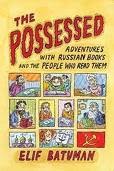
The Possessed - Adventures with Russian Books and the People who Read them


This morning I finished reading Elif graduate studies and research memoirs; I am talking about "The Possessed" by Elif Batuman. Admittedly, this book is different than other books I've read. I liked and learned from it.

Her stories about life in Samarkand was sweet and witty, duck-soup, Satan in belly, Habib the janitor, Gulya and her greed for material life, Dilorom (age of maturity is between 45-60 :)), Muzaffar and his marriage obsessed family. These stories were intertwined with stories about Uzbek language and culture. I really enjoyed reading about Navoi's work, Leili and Majnun, Shrin and Farhad, and The Logic of Birds by Farid al-Din Attar, a Sufi of Nishapur, Iran. It was absolute pleasure to read Dilorom's interpretation of Shirin and Farhad: "the eternal problem of social inequality" and "crop irrigation". The latter refers to the sixty-kilometer canal Farhad carved to prove his love for Princess of Persia Shirin; it is called Farhad-Tarash in local language and located in Province of Kermanshah in Iran.

Her research about Russian literature and history, which side tracked in many different directions, Empress Anna Romanov's lavishes, Babel, Tolstoy and Chekhov, Dostoevsky was very informative. But fell short of the expectation built around the title. Afterall, the title suggests adventures with Russian books.

The last chapter was a shocker! It made me wonder about her real intention of writing this book. Are we reading a mad woman's or a woman madly in love and heartbroken memoirs. Is she ok? In search for an answer, I found this review of the book on slate.com very helpful. Here is an excerpt from the review that answers my question:

She even argues that theory can help us navigate our own lives. When Matej, a charismatic grad student, wreaks emotional havoc on Batuman and her female colleagues (and some of the males, too), she makes sense of him by invoking Rene Girard's theory of "mimetic desire." Beyond all the jokes, this may be the most important contribution Batuman has to make in The Possessed. By fusing memoir and criticism, she shows how the life of literary scholarship is really lived—at its most ridiculous, and at its most unexpectedly sublime.


Overall I found this to be a good, informative, funny book about many different things! It would look better if it were published as a collection of essays or named differently. :)

Wednesday, July 20, 2011

Her Fearful Symmetry, by Audrey Niffenegger

The Time Traveller's Wife, by the same author is an international best seller therefore readers expect a repeat of a similar experience reading this book.
I had not read Audrey Niffenegger's: "The Time Traveler's Wife", in addition I am a novice in the supernatural, paranormal book genre.
When twin sisters Valentina and Julia Pools are told that their aunt Elspeth, who they have never seen, has left them her estate on the condition that they stay in her flat in London, England, close to Highgate Cemetery, for one year, they think this will be a nice change in their aimless lives.
At the age of 20, the twins are still living with their parents, Edwina and Jack, in Chicago. They have pursued higher education only to drop out, claiming that they want to find the subject they both like and more importantly guarantees they can be together all time. Julia, the stronger of the two, is making decision for both of them, unaware that Valentina, the subordinate twin is unhappy with her life in Julia's shadow.
The sisters, each for different reason, welcome the opportunity to live in London on their own for one year. Their mother, Edwina, however is quite worried about the prospects of the twins living on their own in Elspeth's, her twin sister's, flat.
Edwina is keeping a dark secret from her family. The secret explains why Elspeth and Edwina have not been talking, visiting, and writing to each other after Edwina got married to Jack and moved to USA. The only other person who is carrying the dark family secret is Robert, Elspeth's lover, who inherited Elspeth's diaries after her death.
Elspeth's death is an opportunity for this dark secret to be revealed, except for Elspeth is not entirely dead. Her soul is lingering around her flat waiting to be discovered by the twins, Valentina and Julia, and restless to communicate with her lover, Robert.
How and when the secret is revealed to those who don't know it and are most affected by it? Who gets what she/he wants? Who gets what he/she deserves?
There is a lot of twist and turn to the story and the events leading to secret being revealed become really bizarre and unrealistic. The main point of the story, I think, is love: love between the twins, and between the couples, when alive and after they die. Although about love the language is hardly romantic; and the events showing the love is built on trickery.

Sunday, June 05, 2011

Random Hacks of Kindess #3, Toronto


We live in a fast paced world. But every once in a while we get to stop and smell the roses. For me attending RHoK#3 Toronto was like "smelling the roses".
This was my first RHoK, (pronounced rock). I went to the event not knowing what to expect and came out of it expecting to attend every future RHoK organized, (next one is in October, check it out!).

It was a surreal experience and I tell you why. Firstly, the event was well crafted and get this by a group of volunteers who had taken care of everything: from finding a good location to host the event, OISE UofT, to sponsors who provided food, and snacks, (loved the Kinder Eggs, thanks!), to freebies, even to live streaming of the Stanley Cup Finals, (hacking while watching hockey, cool!). Secondly, the individuals who attended the event, I must add: from all walks of life, had one common goal/interest: to be part of a solution. Thirdly, and this impresses the most, the teams made of these individuals were able to design, develop a solution for a problem definition in a day.

Let me tell you my story attending RHok#3. I joined the Wound Classification Application team. The problem, suggested by Yaser Alyounes, was to design a prototype for an application that will be used in refugee camps or in areas troubled by war to streamline the process of classifying war wounds by taking pictures of the wounds. The benefits triaging the wounded far from qualified doctors and facilities quickly and efficiently.

We had very talented individuals on our team who quickly dissected the problem, analyzed each piece, and constructed the decision tree. By 12:20 pm we had a flowchart and owners/developers for each section. Some dived deep in the areas of their expertise and others researched, downloaded, and mocked around with software and source that were unfamiliar with.

I worked on the FrontlineSMS, an application that allows user mass communication via text
messaging. FrontlineSMS is an open source project that has been used in disaster relief situations. By connecting a mobile device, or a GSM modem with a SIM card to the computer where FrontlineSMS is installed you can send and receive messages to other devices that accept text messaging. I had some problems with the software, but I was able to test its send and receive capability, literally at the eleventh hour. By that time the team had decided to replace FrontlineSMS with a phone application that would let the volunteer to identify the four coordinates of the picture taken of wound. :) The coordinates of those four points will be sent from the app to the database. Once they are in the database, the algorithm calculates the dimensions of the wound based on those coordinates.

All in all this was great fun. Events like RHoK makes solving problems that our world is struggling with so much easier.

A big shout out to all those behind RHoK!

Friday, May 06, 2011

What's next for Canada in the next four years? 2011 - 2014

This will be the last post on politics, at least for a while. the past election was an opportunity to dive into an unfamiliar area of knowledge; I gathered information about policies and understood less, because one contradicted the other. How could we cut deficit when we want to spend billion dollars on, unfortunately, stuff that in no way and shape boost our GDP?! How could we cut deficit when we intend to reduce corporate taxes?! Where is the revenue going to come to balance the spending?

I am befuddled!

Rick Mercer, Canadian political satirist, encouraged all of us to vote; his vote rant to, specially, encourage the young demographic was quoted in newspaper, on Facebook and other places. Here is a quote from the rant:

So please, if you're between the age of 18 and 25 and you want to scare the hell out of the people that run this country, this time around do the unexpected. Take 20 minutes out of your day and do what young people all around the world are dying to do.


Quite true. There are people who are giving up their lives to earn the right to vote for the future generation of their country. Voting has been the symbol of democracy.

I voted!

Once all votes were counted and results were announced, I felt no one heard or cared about what I voted for. My one vote had very little effect on the outcome.

What now? Well, Mr. Mercer we need a follow on rant to tell us what is the next step for us "in the country with one of the greatest democracies on earth." :)

Mr. Stronach suggests “people representatives” that will work alongside the elected parliamentarians to vote on the legislation proposed. This is a start to thinking beyond the once in a four years chance of influencing the future of the country. It high lights the need to understand how democracy can lead to prosperity and security. This proposal is made by a man who has built a company of $25 billion a year in sales which started its humble beginning in Toronto forty years ago.

I hope some one is listening; especially the educators. It's important to build a knowledgeable body who understand business in the context of policy making. And it's important to encourage this body of knowledge to then proceed into policy making jobs in government. This will, hopefully, put an end to making conflicting promises just for the sake of being re-elected.

What's next for Canada in the next four years is, what we want it to be. And this is not an idealistic rhetoric. There are many grass roots movements in this country that tackle the real issues.

Democracy is definitely NOT what this cartoon says!

Friday, April 22, 2011

Should a candidate earn my trust before earning my vote?

Living in a country with a voting and multi-party systems one bears a great responsibility and that is "NOT to take democracy for GRANTED!"

I love this quote by Joe Wilson.

The responsibility of a country is not in the hands of a privileged few. We are strong, and we are free from tyranny as long as each one of us remembers his or her duty as a citizen. Whether it's to report a pothole at the top of your street or lies in a State of the Union address, speak out! Ask those questions. Demand that truth. Democracy is not a free ride, man. I'm here to tell you. But, this is where we live. And if we do our job, this is where our children will live.


I heard this quote for the first time in the movie Fair Game, based on the true story of a secret CIA agent, Valerie Plame, whose identity is revealed by the U.S. authorities as way of silencing her husband Joe Wilson, who wrote an article for New York Times criticizing the Bush administration move to attack Iraq based on alleged possession of weapons of mass destruction.

With a federal election looming, I feel more than any time else under pressure to realize my duty as a citizen. To cast a well-informed vote.

There is abundant of information available. The information is only as good as the people who provide it. I refuse to trust one without trusting the other. Therefore, I have a dilemma. None of the candidates, and or the party leaders have done anything to earn my trust.

Sunday, April 10, 2011

Promise: Tax Cut Test ... A thumbs ....

I spent the last two hours researching tax cuts. Before, I share the "new found knowledge", I have to write the motivation behind seeking the knowledge. I have to vote on May 2!

The phrase tax cuts is frequently used in a non-fact based rhetoric by politicians as a way of promoting the partisan agenda of the party. Although there is nothing offered in the promise to substantiate what tax cut means, the term has a very powerful effect on non-interested voters, who will give you five minutes to make your pitch, and casual voters, who will skim literature, read headlines and can be seduced by a meaningful phrase.

I skim literature and read headlines, but I am a skeptic and do my own research and find my facts before believing what I read, or hear.

Here is what I found out around and about the world wide web on this topic.

The tax cut increases disposable income and encourages consumer spending. The increase in consumer spending increases the GNP, Growth National Product, which is an economic indicator of nation's wealth. At the same time the tax cut decreases government revenue which may create a budget deficit, or prompt cut on many government funded or subsidized programs to avoid the deficit.

Taxes are a percentage of a value, where percentage is 1, 2, 16% and the value is income, price of goods or any other item or category that is taxed. Clearly the larger the value the higher the tax therefore lowering the tax rate is equal to higher savings. For example lowering sales tax by 1% will save ~$150 on the purchase of Honda Fit ($14,480 CAD) and ~$400 on the purchase of a Mercedes C 250 ($38,800 CAD).

Bottom line the major benefactor of tax cuts are those who are well-off and don't rely on any federally funded program.

Canada has the lowest Corporate Tax in the Group of G7, 16.5%. The government is going to decrease this rate further by 1.5% to 15% (effective Jan 2012). The budget deficit is $5.93 billion. Government needs to think strategically and prioritize according to what is needed for the majority of the citizens not a select few.

My verdict for the platform who is committed to lowering the corporate taxes further before the federal budget deficit is handled is a big thumbs down.

Saturday, March 05, 2011

Can one make a "project" out of "happiness"?

I turn everything into a project. I have projects tackling career, relationship, and house chores. I break each project into smaller projects and then assign each a date. I track my progress diligently. If I procrastinate I start making notes to myself. The notes are supposed to serve as reminders; but they become source of frustration. Source of frustration because I dislike clutter. When I see one of these notes, I become more motivated to complete the task jotted on it so I can get rid of the note itself.

I am so comfortable with "projectizing"!

However, I have to admit the title of the book I recently read, "The Happiness Project" by Gretchen Rubin, made me uncomfortable at first. I couldn't imagine an end date for such project, in fact nothing about it fit the definition of a project.

A project, by definition, is a temporary activity with a starting date, specific goals and conditions, defined responsibilities, a budget, a planning, a fixed end date and multiple parties involved.
Source: http://www.softwareprojects.org/project_intake_reasons22.htm


I have always been curious about the topic. Is happiness a "what" or a "how"?
What makes me happy?
OR
How do I become happy?


Is it one or the other, or both? Does it matter? Should we think about it? Probably, yes! Somewhere in the book, Rubin asks this question on her blog , "When is the right time to think about happiness? Before or after catastrophe strikes?" . Some of the high lights of the comments are in the book. One person's comment stood out for me.

money, you can't save for when you get laid off, after you get laid off; rather, you have to save while you have a job and the money is still coming in. Life is like that, you have to DO while you are able to think of what you want, what you like, what needs it will fill, how it will enhance your life, how it will help you to maintain you, so that you have some reserves when cruch time comes.


Rubin's approach in finding happiness is very "systematic". Hence the name "project" is appropriate, (I found this out after reading the first two chapters.) She has been honest. Honest, because she doesn't imply that her book is a one hat for all, example: those who look for a philosophical way of discussing, what is happiness, or how to be happy know what not to expect from the book right away.

Honesty is the trait that Rubin demonstrates frequently in her writing. She builds her stories around facts, her former profession, related to Law, is probably the reason she is diligent about not coming across as phony or pretentious. I liked that about her writing.

Rubin's message is: I have to be happy. It sounds selfish, but if I am not, I will make people in my life unhappy. To become happy could be as simple as taking a look at my day to day movements, existence and identifying areas for improvement. This is something I can relate to. Once I have less clutter in my life, or I am more on top of my to-do-list, or I am more in touch with people I love and care about; I am happier. If I am happier, I am more productive, become better at what I do, and the world becomes my oyster!

Monday, January 31, 2011

The impact of pervasive computing on the education system

Here is an interesting fact: the term pervasive computing was introduced by IBM in 1999. What it means is: technology is available anywhere at anytime. This vision for the future of technology continues to change the way we live, socialize, have fun, and learn.
I am curious about the impact it has had in the way we learn, more specifically in the classroom; on the education system.

Today a plethora of computing solutions are available to students from a early age.
From tool based applications such as word processor and spreadsheets, modeling soft- wares to emails, podcasts, blogs, and much more. What impact has technology had in facilitating education?

The most famous study done in this area is ACOT, Apple Classrooms of Tomorrow. Since 1985, the Apple Classrooms of Tomorrow (ACOT)SM research project has provided teachers and students at five public school sites in five states in the US with individual computers for use at school and at home. Students and teachers also have access to video, printer, scanner, CD-Rom drives and hundreds of software packages.

On an on going basis the changes of the behavior of students in the classroom has been observed and documented in this research project.


In the report ACOT teachers rave about the positive impact introducing technology has had in the process of learning. Here are three examples:

  • access to modeling software has made the learning of math more attractive to the students
    ACOT students' grades were marginally better or neutral relative to the grades of students who don't use technology in the classroom. This implies that what teachers indicate as "attractive" has more to do with the students' reaction to math and not necessarily their understanding of it. In other words the technology has not been able to facilitate learning of math concepts.


  • access to technology has improved the spirit of team work and collaboration; the usual example in this space is access to the world wide web, pod casts, emails and blogs. these tools have opened up a world of opportunities for both students and teachers to learn and share experience.
    Collaboration and team work has always been at core of education. The interaction students have with each other is the only reason they learn. The time students spend on the world wide web, and listening to podcasts can only reduce the time they spend with each other. In fact in another section of the report we read: students reluctantly leave their classroom during the recess.


  • access to tool based applications such as word processor and spreadsheets improves students organization skills
    An essay written on paper using a pen and pencil is many times richer in content than a word processed one, where half of the productivity time is spent on undoing and redoing the cosmetic changes. Similarly a statistic problem done without using the spreadsheet allows students to learn and reinforce their learning of math operations.


As you see, I am a skeptic!


What I am afraid is happening is education system is becoming a market place for computing companies. The research projects funded by them is biased; of course from their point of view the impact of technology in the classroom is positive and improves the process of learning. The educators, however, need to think more critically. Instead of glorifying all that technology has provided to the classroom, they should think about what it has taken away from our learning process. Only in this way we can discover the best use of technology in our education system.


Tuesday, January 04, 2011

Little Bee, Chris Cleave, A novel

This book has received great reviews and the status of New York Times Bestseller. I started reading it the day I got it from the library not knowing what to expect. The picture on the cover shows a girl with curly hair; the book title, "Little Bee", doesn't provide much of a clue to the reader about the story content.

I soon found out that Little Bee is the name of one of the two protagonists, and I am guessing the drawing on the cover is her, although, as I read more about her, I pictured her differently.

Little Bee is a sixteen year old Nigerian refugee, she is the last member of her family. Everyone else is dead. With all she had to witness, one wonders if she is better off dead or alive. She travels thousands of miles to escape death but she is always ready to take her own life when the "men come".

The other protagonist is a well off journalist, Sarah Summers-O'Rourke, who lives in the posh suburbs of Kingston upon Thames, with her husband, Andrew O'Rourke, also a journalist. They have a four year-old Batman-costume-wearing son, Charlie. Sarah although a caring mother but she is an unfaithful wife.

These two strangers whose vastly different lives would make it highly unlikely to cross path are both in search of a new beginning, when a horrific event on a Nigerian beach connect their lives for good.

I think Mr. Chris Cleave's true intention of crafting the story of Sarah and Little Bee is to bring to our attention the murder, torture and unfair treatment of thousands of innocent people living on oil rich lands in Nigeria and the mass exodus of the survivors (of these attacks) who sought refuge from countries such as Britain, only to find themselves in inhuman, harsh and painful situations at the refugee detention centers of these countries.

It's a good read!

A National Bestseller...A New York Times Bestseller...Shortlisted for Costa Novel Award, Commonwealth Writers' prize....Best Book Europe and Asia.


Praise for Little Bee comes from all over!
The Guardian UK calls the Book, "Ambitious and Fearless"

The Globe and Mail Canada refers to it as, "Enthralling"

Sunday, December 26, 2010

I am a zipster now

I lost all the motivation to buy a car, when I moved to the city with a reliable and well connected public transit. I was not able in any shape or form justify the cost of a car and car insurance especially when my residence is close to subway station, one connecting me to North and South of the city and the other connecting me to the East of the city. But still there were days, winter, windy, rainy, shopping days, that I wished I could have the convenience of the car without the "inconvenience" of the monthly cost.

I learned about the rental companies in my neighborhood and started using them on an on demand basis. Around the same time, I learned about zipcar. I decided to prefer renting to car sharing, because I was convinced that the North American mind set will never give a chance to car sharing to grow and flourish.

I stand corrected! Car renting is becoming a thing of a past.

I became a zipster and have been enjoying the ease of use, the efficiency of service and the low cost --all at the same time.

zipcars are readily available in the neighborhood*. They can be booked any time, even minutes before the time of pick-up (upon availability)**. The price includes gas and insurance***. They can be booked for one hour or for one day; the booking can be extended****. The entire process is green; everything from booking to billing is done on-line (e-mail and/or text); which means no more receipts to carry around.

Companies have rules; if broken there are fines and penalties! Those who read the rules will never get burnt, for the rest there is learn by experience (a.k.a the hard way!)

Zipcar is no exception. Consider the following as an introduction to the Zipcar rules:

*Although they are all over, (50+ cities in US, Canada and UK and 100+ university campuses in North America), but coverage may be sparse in the neighborhood you work, play or live. The locations are decided based on the demand. They are good about showing you the zipcars in your city.

**You can change or cancel your reservation with no penalty:
-for reservations less than 8 hours long, you've got until 3 hours before the start of your reservation.
-for reservations 8 hours or longer, you've got to do it at least 24 hours in advance.
Since you can book minutes before your planned departure this should not be a problem, unless you like advance booking but change your plan haphazardly.

***Yes, the price does include insurance, but they charge you $750 damage fee, unless you sign up for a waiver which costs $5 per month.
I don't quite understand the logic behind this rule; if insurance is included in the price then what's the $750 damage fee? Let me know if you have this figured out, will you?

****Half an hour before the end of the reservation they send a text to remind you that time is almost up and you've got to return the car or extend your reservation. They value punctuality, so much that they charge you a late fee if you run late. And don't you think that they will not find out --after all there is no one there to check you in or out you may think. The smart technology built in your zipcard will let them know. Intriguing, eh?
Well, if you are good in managing your time then this is not something you need to worry about. And for the rest of us, this is a great way to develop and practice the essential time management skill. Value your time, dude!


You've got questions and/or concerns that are available 24/7 year round to answer and/or address them. Call them up. The prompts quickly connects you to the right person or panel (if you choose to DIY). The agent, I spoke with, Sunday morning 8:17 AM, was able to give an answer to my question very quickly.

So, what's the cost to become a zipster in T.O.?
-a one-time non-refundable application processing fee, $35 + HST
-a non-refundable annual fee, $65 + HST (refundable within the first 30 days of signing for the service)
-pay per use of ~$8/hour the week and ~$11.75/hour the weekend, plus good deals M-Th after 6PM

Whereas with rental cars, I paid for the whole day and used it for maybe 3 hours, with zipcars, I pay for 3 hours and use it for 3 hours.

Live long car sharing!!